
ACTivate Classrooms
ACTivate Classrooms provides teachers with the knowledge and tools to explore important global topics that can sometimes feel difficult or sensitive to address. The programme offers in-depth training on key themes in Global Citizenship Education (GCE), along with practical guidance on how to approach complex issues, including activism.
Led by a team of international experts, ACTivate Classrooms goes far beyond surface-level professional development. It encourages critical, reflective, and research-informed engagement, supporting meaningful classroom discussions that connect theory with real-world challenges.
ACTivate Classrooms warmly invites teachers and schools worldwide to join us in fostering informed, engaged, and empowered learners.
We offer a range of tools created especially for teachers, including MOOCs, practical guidance resources, classroom-ready tools, and engaging materials for students.
We are happy to collaborate with schools. See some of our previous events.
Massive Open Online Course (MOOC) on Global Citizenship Education (GCE)
Education is about more than just facts; it’s about fostering ethically responsible and critically engaged learners. Our free MOOC gives you the tools to integrate Global Citizenship Education seamlessly into your curriculum.
What You’ll Gain:
-
Practical Pedagogy: Real-world strategies to bring GCE principles into your daily teaching.
-
Critical Thinking: Develop your own perspective through high-level scholarly dialogue.
-
Flexible Modules: Revisit content whenever you need a refresher or focus only on the sections most relevant to your class.
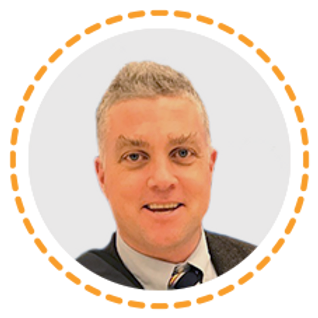
| The History of Global Citizenship Education
Prof. Noah Sobe (Loyola University Chicago), former senior project officer at UNESCO’s Future of Learning and Innovation team. |
 |
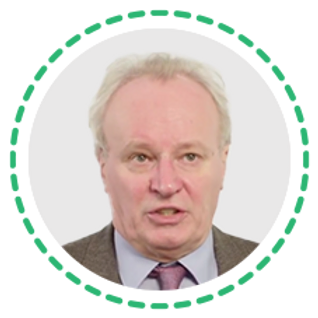
| Philosophical foundations of Global Citizenship Education
Prof. Douglas Bourn (University College London), director of the Development Education Research Centre at University College London, Chair of Global Learning London, author and editor on global education and social justice. |
 |
| Critical approaches to Global Citizenship Education
Prof. Laura Engel (The George Washington University), professor of international education and international affairs at The George Washington University, and co-chair of the GW UNESCO Chair in International Education for Development. |
 |
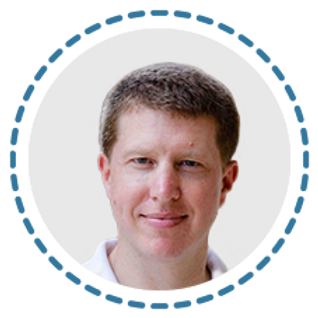
| Class and gender in Global Citizenship Education
Prof. Garth Stahl (University of Queensland), research Fellow (ARC DECRA), specialising in education, identity, equity, and the sociology of schooling in a neoliberal context. |
 |
| International organizations in Global Citizenship Education
Prof. Nina Kolleck (University of Potsdam), professor of educational and socialisation theory at the University of Potsdam, and advisor to federal ministries and scientific boards. |
 |
| Students’ agency in Global Citizenship Education
Prof. Gustavo Fischman (Arizona State University), professor of educational policy and comparative education and the director of Scholarly Communications at Arizona State University’s Mary Lou Fulton Teachers College. |
 |
| Why some countries oppose Global Citizenship Education
Prof. Katarzyna Jasikowska (Jagiellonian University), professor at the Institute of Sociology, Jagiellonian University, specialising in global education, climate activist and coordinator of the university’s Climate. |
 |
| Discussion with Prof. Miri Yemini on the implications of Global Citizenship Education
Prof. Aaron Benavot (University at Albany-SUNY), professor of global education policy at the University at Albany-SUNY, former UNESCO senior analyst and director of the Global Education Monitoring Report. |
 |
Guidance tools for practical implementation
Research shows that classroom discussion is often treated mainly as a way to meet curriculum requirements, rather than as an essential skill in its own right. Yet the ability to engage thoughtfully with public and global issues is fundamental to democratic citizenship. In practice, many teachers feel uncertain about addressing controversial topics or worry about how to remain neutral, which can limit opportunities for meaningful civic discussion in schools.
To better understand how these conversations can work in real classrooms, STUDACT researchers conducted more than 150 discussion groups in schools across six countries. These discussions were highly successful in terms of student engagement and participation, and they consistently revealed that students want opportunities to explore complex political and global issues. Students also identified teachers as trusted moderators who can create safe spaces and guide thoughtful, respectful dialogue.
Meet the researchers behind our global focus groups! In this three-part video series, our team shares what they learned while speaking with students in Australia, Italy, Poland, the UK, and the USA. They dive into what activism looks like for today’s youth, how social media is transforming the way young people take action, and the most surprising discoveries from their conversations with secondary school students.
|
Here is the selection of engaging activities designed to empower students’ exploration of concepts such as activism, global issues, and civic engagement. These activities build students’ knowledge and vocabulary, while also highlighting that young voices can drive real societal impact.
This activity immerses students in simulated activism scenarios. They can choose a cause they care about and explore various advocacy strategies, such as online campaigns, peaceful protests, petition creation, and lobbying efforts. The game features two levels tailored to provide age-appropriate challenges and inspire strategic thinking.
Play our interactive scenario game here:
 |
 |
| Voices for Justice: Save the Forest
Suitable for primary school students |
Voices for Justice: Global Human Rights
Suitable for secondary school students |
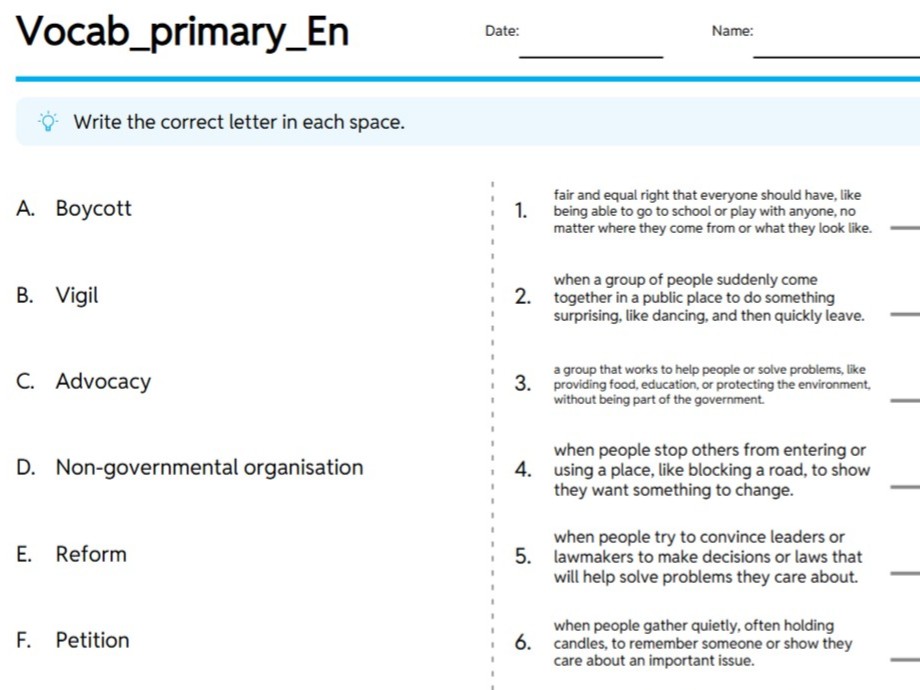
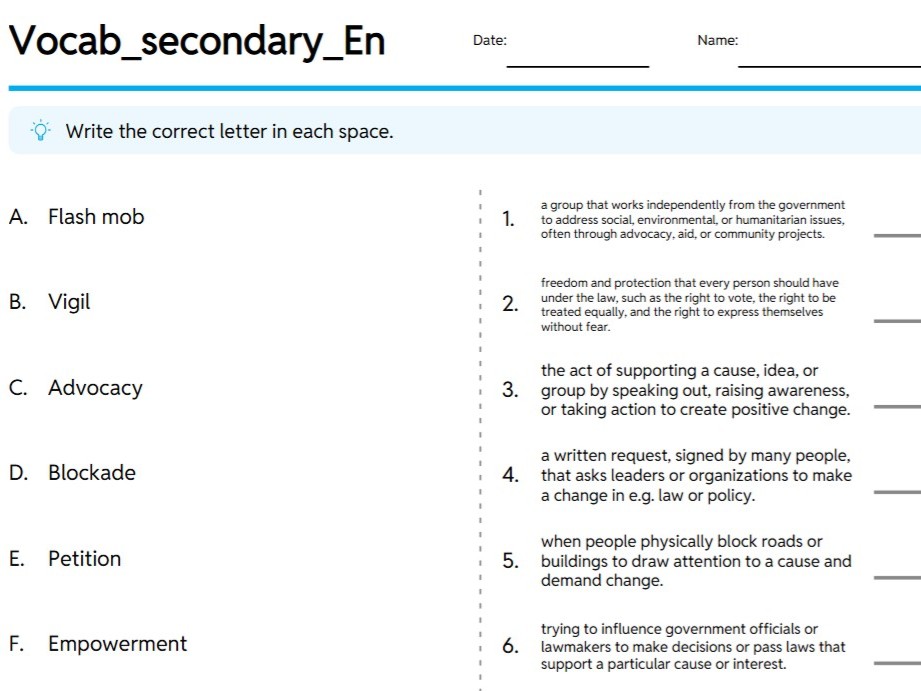
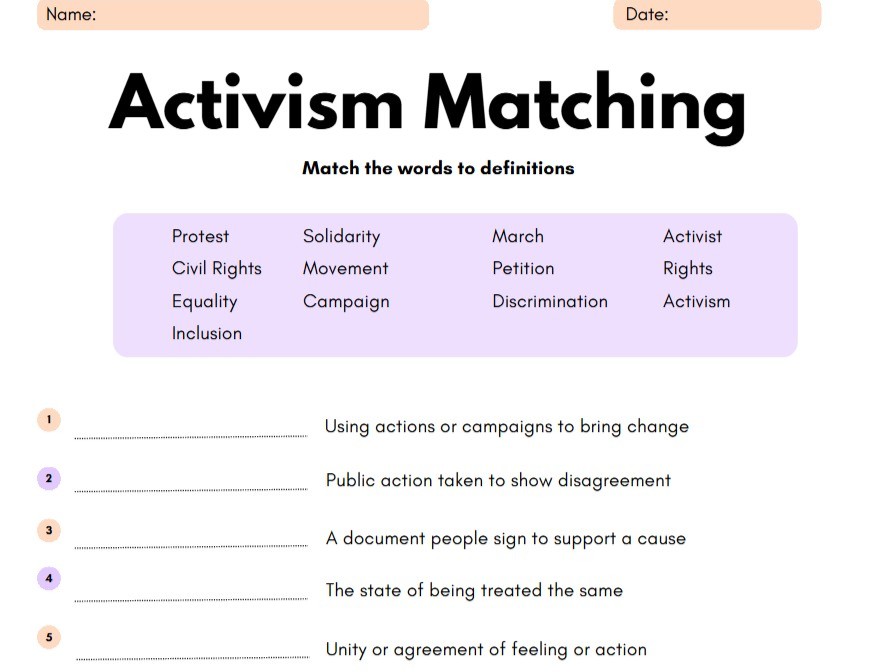
To deepen students’ understanding of activism terminology, this game introduces key terms related to advocacy and civic engagement. It aims to enrich language skills and build confidence in discussing social issues in a way that is both educational and enjoyable. Engage students with activism vocabulary:
 |
 |
 |
| Vocabulary game (primary school) | Vocabulary game (secondary school) | Vocabulary game (primary and learning diversities) |
Young voice matters and can impact real change.
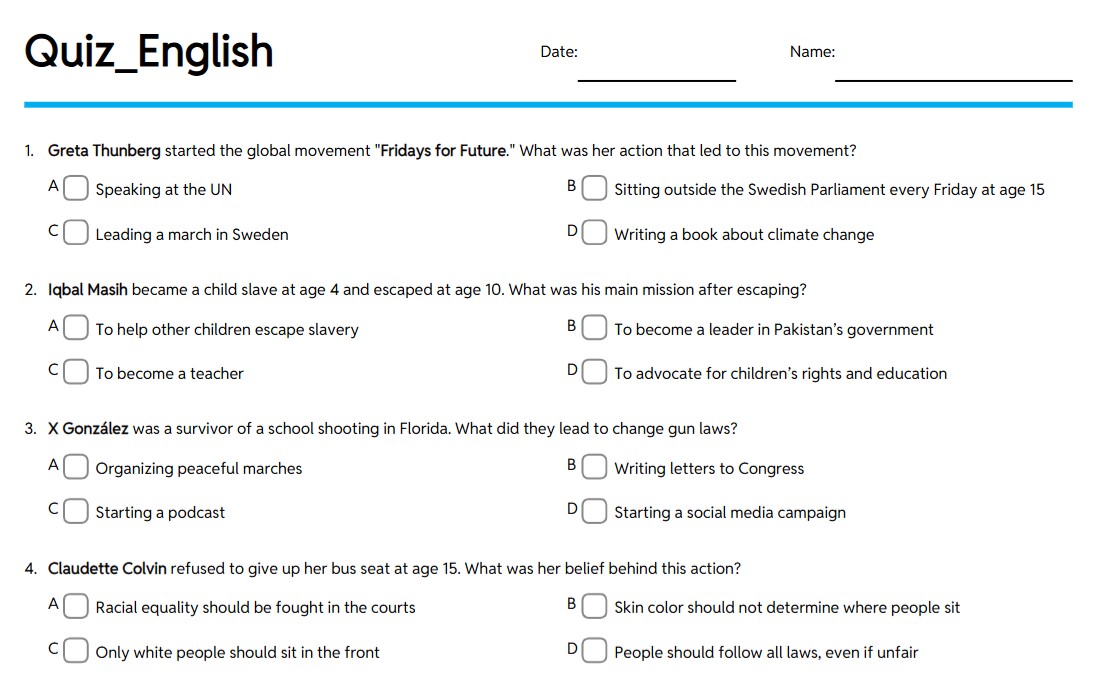
Show our presentation on influential young activists and follow up with the friendly quiz.
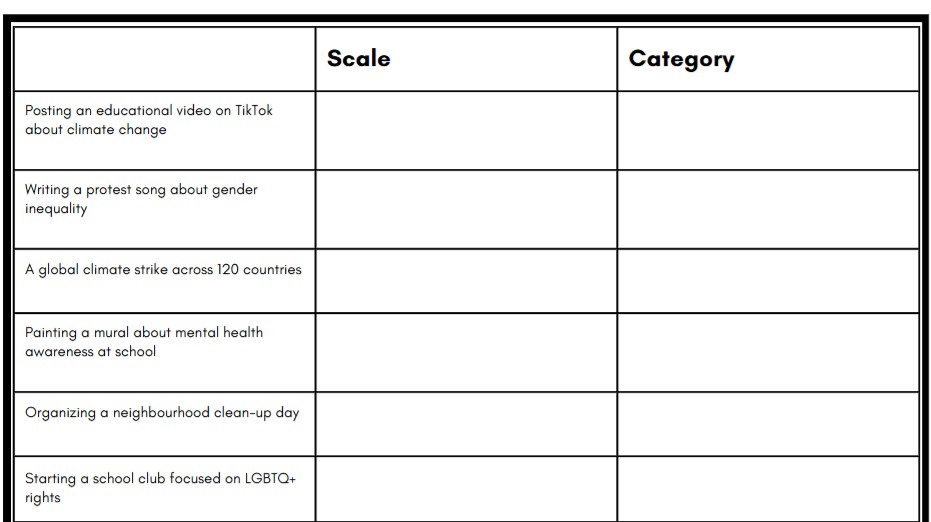
Help your students discover their voice with our curated activities on community activism. Explore different levels of impact and start a conversation that leads to real change:
 |
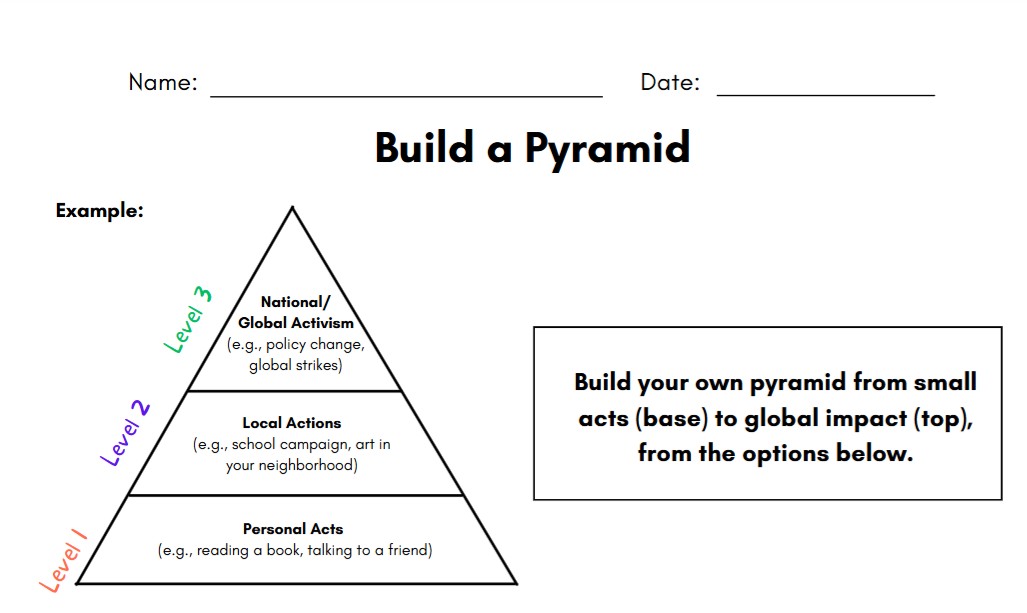 |
| Scale and Category of Activism | Build a Pyramid |
Works of the students
To bring the topic of activism to life, you might invite students to express their views by producing posters, videos, interactive quizzes, or other multimedia projects. Here are some examples from the students with whom our research team worked with:
| Ask students to create posters or flowcharts that translate complex global issues into clear, visual messages, helping them practice the art of advocacy and public communication. | 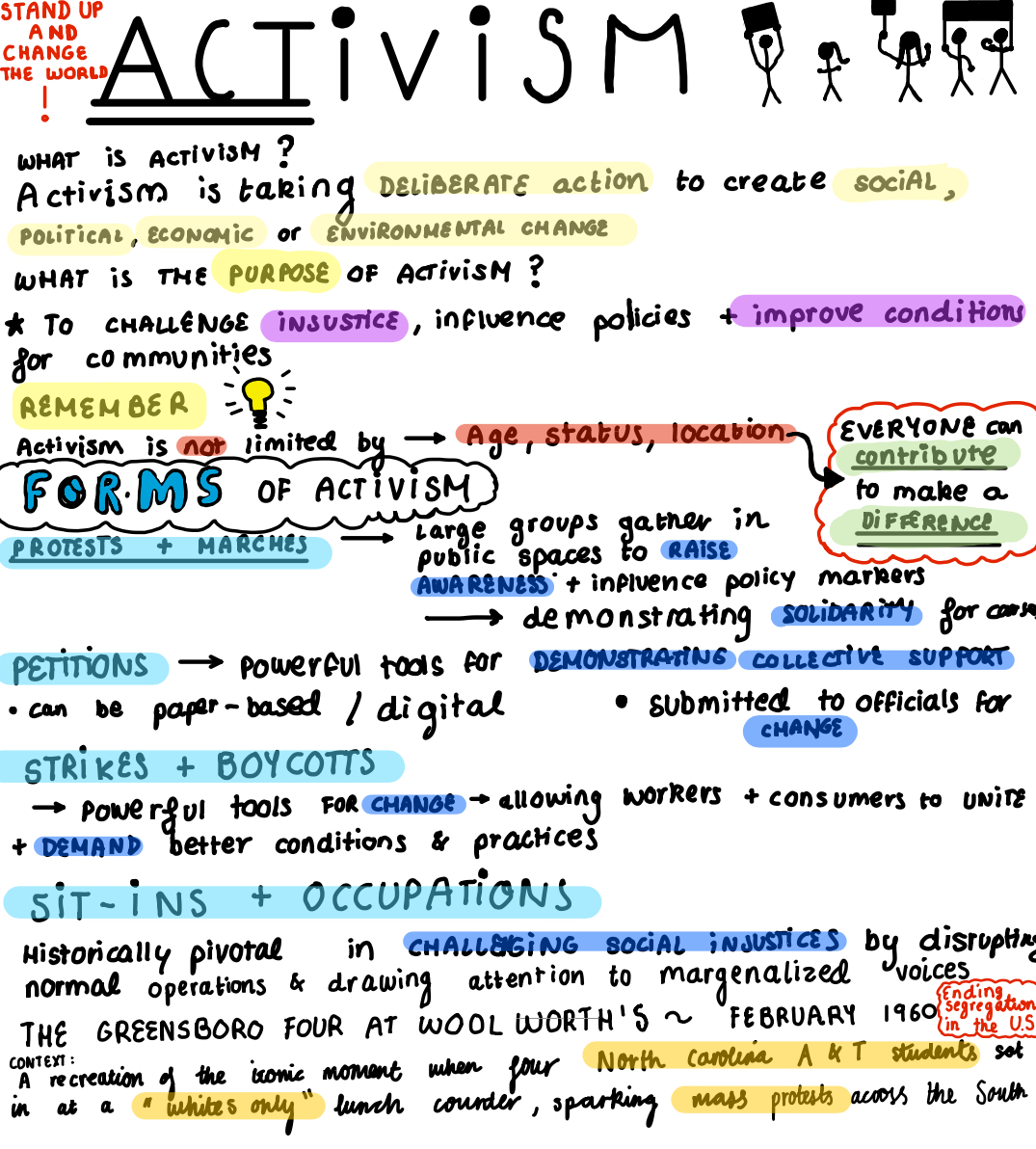
(by Isabel, Spain) |
| You can ask students to create quizzes, using applications such as Blooket, Kahoot, Quizizz. Here are some examples that students created, and that you and your students can play.
Activism – Details – Kahoot! Crystal, Myanmar ACTivism – Assessment | Quizizz Majid, Azerbaijan |
Events
Learn more about People&Planet Lab on Instagram.
| 22/10/2025 |
P&PL visit to Younited School
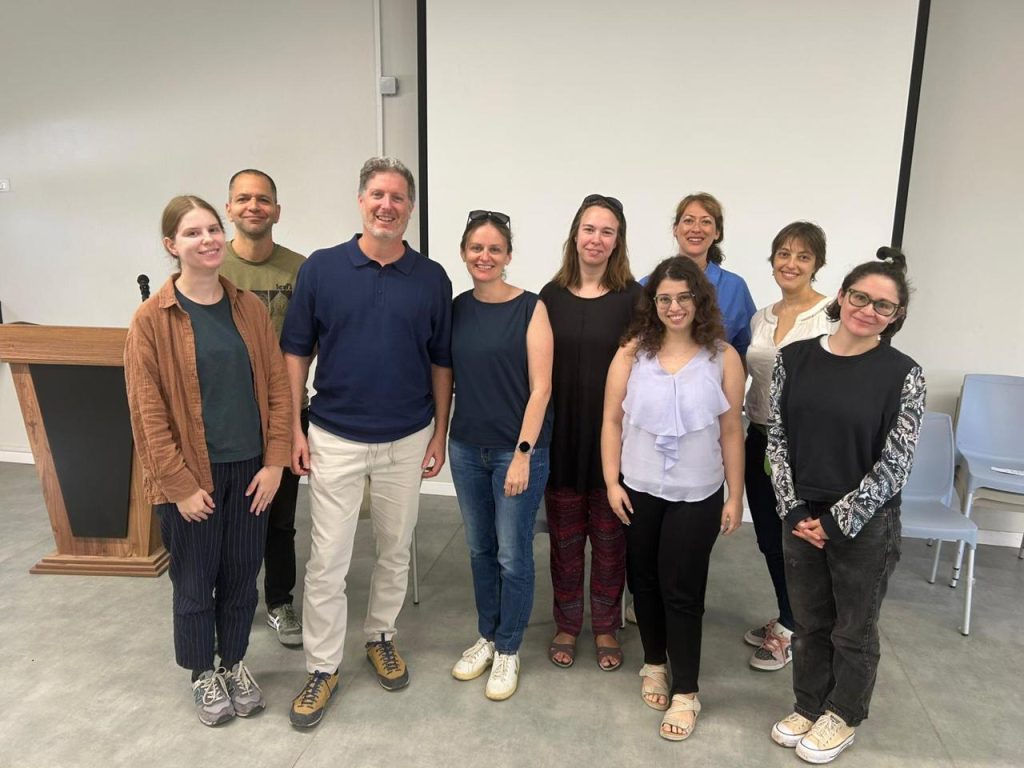
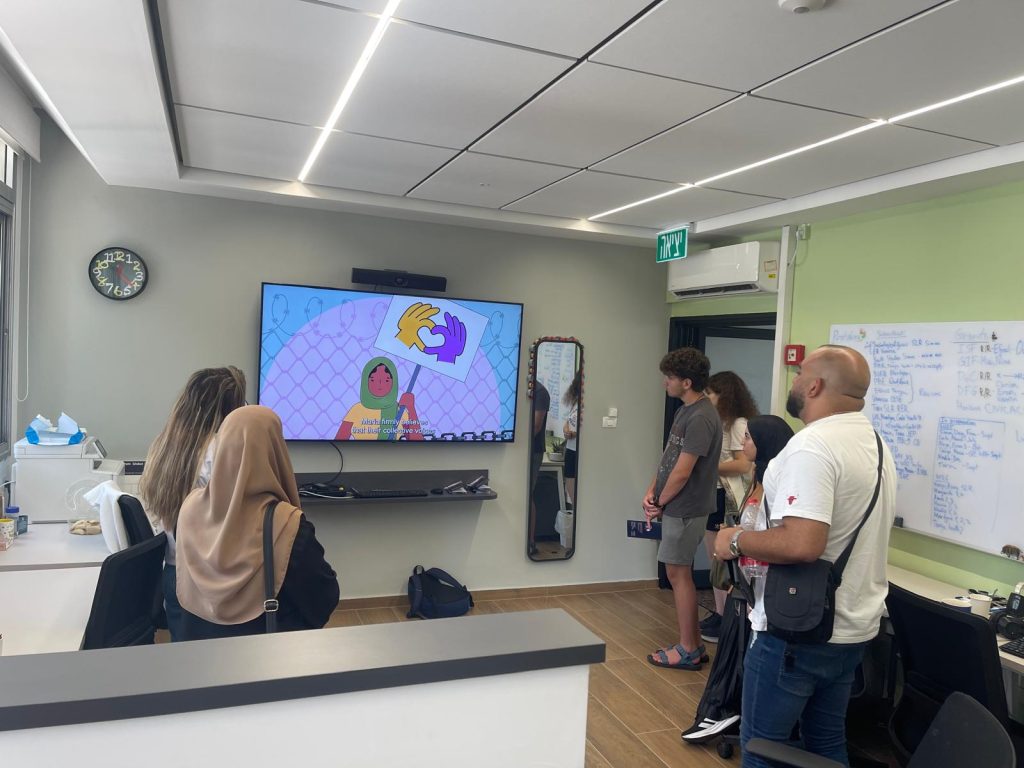
On October 21st, our laboratory team from the Technion Faculty of Education in Science and Technology embarked on an insightful visit to Givat Haviva Education Center and Younited School. The delegation engaged in meaningful discussions with the school’s head, Yuval Dvir, the Givat Haviva executive director, Michal Sella, teachers, mentors, and students, gaining a deep understanding of an innovative educational approach that prioritizes community integration and cross-cultural learning. |
||
| 06/08/2025 |
Lab participates in Technion’s Scientific Faculties Open Day
Our lab recently took part in Technion’s Scientific Faculties Open Day, held on Wednesday, August 6th, 2025, on the Technion Campus in Haifa. As part of the Faculty of Education in Science and Technology’s participation in the event, our PhD student Amos Lagziel engaged with visitors, sharing insights about our current research projects and laboratory work. The open day provided an excellent opportunity to connect with prospective students and the broader community, showcasing the innovative research happening within our department. Visitors showed great interest in learning about our ongoing studies and the impact of our work in science and technology education. We look forward to participating in future outreach events and continuing to share our research with the community. |
||
| 15/03/2025 |
Lab team engages young minds at “Science is Wonderful!” event
|
||
| 04/09/2024 |
STUDACT – New massive open online course on global citizenship educationESD and global citizenship education complement each other in a quality education as stated in SDG 4. Check out this new opportunity,supported by the European Commission, to learn about global citizenship. This course is designed to provide learners with a comprehensive understanding of global citizenship education and its importance in today’s interconnected world. Over the course of several modules, we will explore the meaning and significance of global citizenship, and the role that education can play in promoting global citizenship values and attitudes. We will delve into various topics such as human rights, sustainability, social justice, and cultural diversity. From the website of International Association of Universities (IAU): https://www.iau-hesd.net/action/studact-new-massive-open-online-course-global-citizenship-education |
||
| 22/05/2024 |
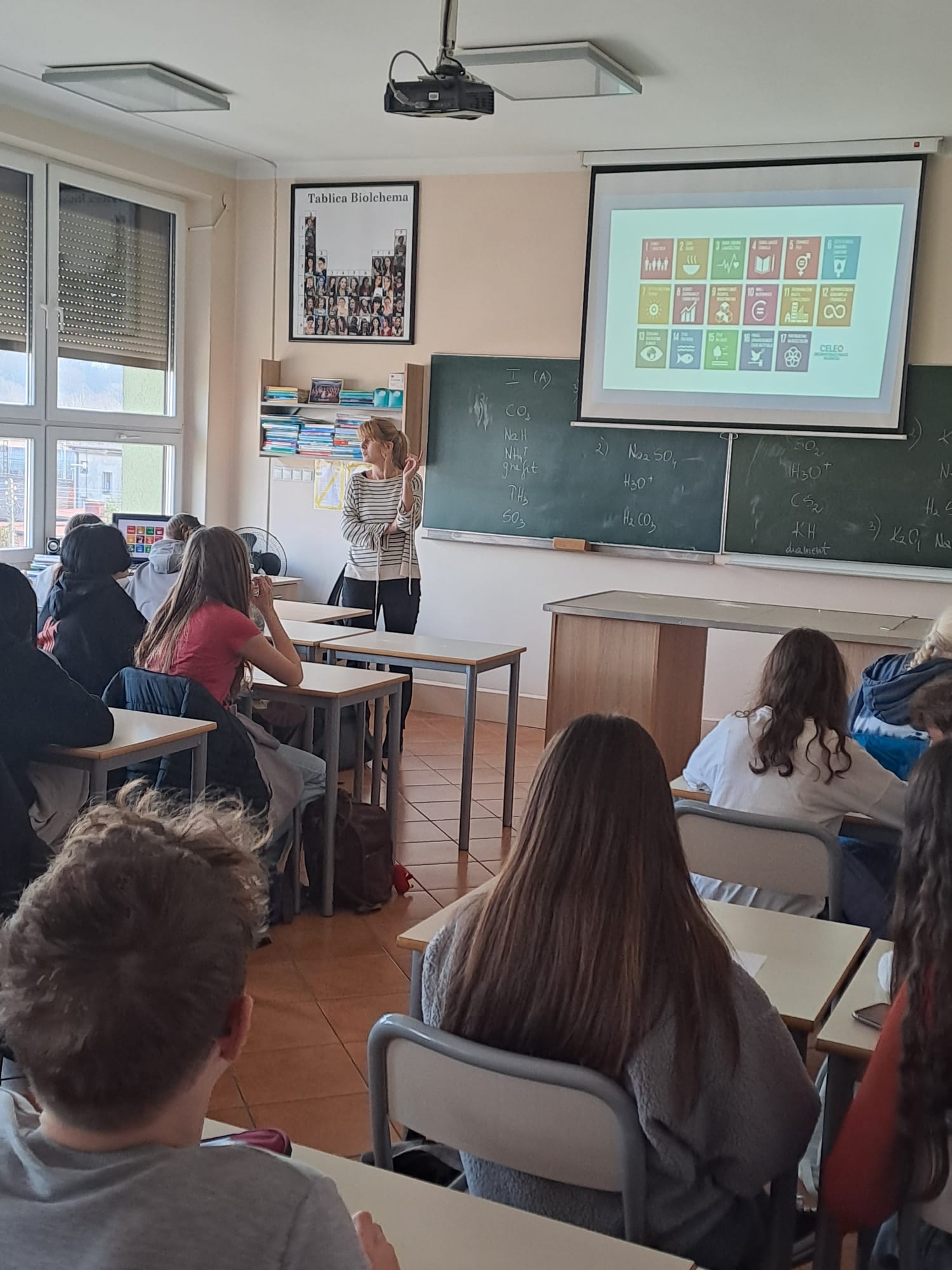
Our youth’s participation in the international “STUDACT” project
STUDACT is an international research project concerning global education and the broadly understood engagement of young people in global issues. Global Citizenship Education (GCE), known in Poland primarily as global education, is a key task to be accomplished by 2030 as part of the UN Sustainable Development Goals. This education has the potential to transform education systems, enabling learners to build more peaceful, tolerant, inclusive, and safe societies. However, without systematic research that would show how it is understood by students, there is no hope for real progress by 2030. The STUDACT project is coordinated by the Israel Institute of Technology (Technion) in Haifa, and in Poland it is implemented by Jagiellonian University in Kraków. The project leader is Prof. Miri Yemini, while in Poland the project is supervised by Prof. Katarzyna Jasikowska. In February of this year, Post-Primary School Complex in Wodzisław Śląski hosted Dr. Martyna Elerian, who conducted research on global education in selected discussion groups of students from II LO and LSP. This study included students from several schools in Poland, the United States, Great Britain, Australia, Germany, and Italy. During her stay at our school, Dr. Martyna Elerian additionally conducted workshops with lecture elements on Global Education for students of class 1C and invited students from SP1 in Wodzisław Śląski, as well as in English for classes 3A and 3B. Last week we received thanks for participation in the research from the project leader – Prof. Miri Yemini. From the website of Post-Primary School Complex in Wodzisław Śląski: https://tischner-wodzislaw.pl/index.php?option=com_content&view=article&id=1630&catid=15&Itemid=509 |